

By: Dr. Farida Faisal

Why judging universities through social media claims and global rankings alone tells only part of the story
Having spent more than three decades in Pakistan’s higher education sector, I have witnessed periods of remarkable growth, persistent challenges, and constant change. What I find increasingly concerning today is not criticism of universities—which is necessary and healthy—but the rise of simplistic social media narratives that reduce a complex reality to a few provocative sound bites.
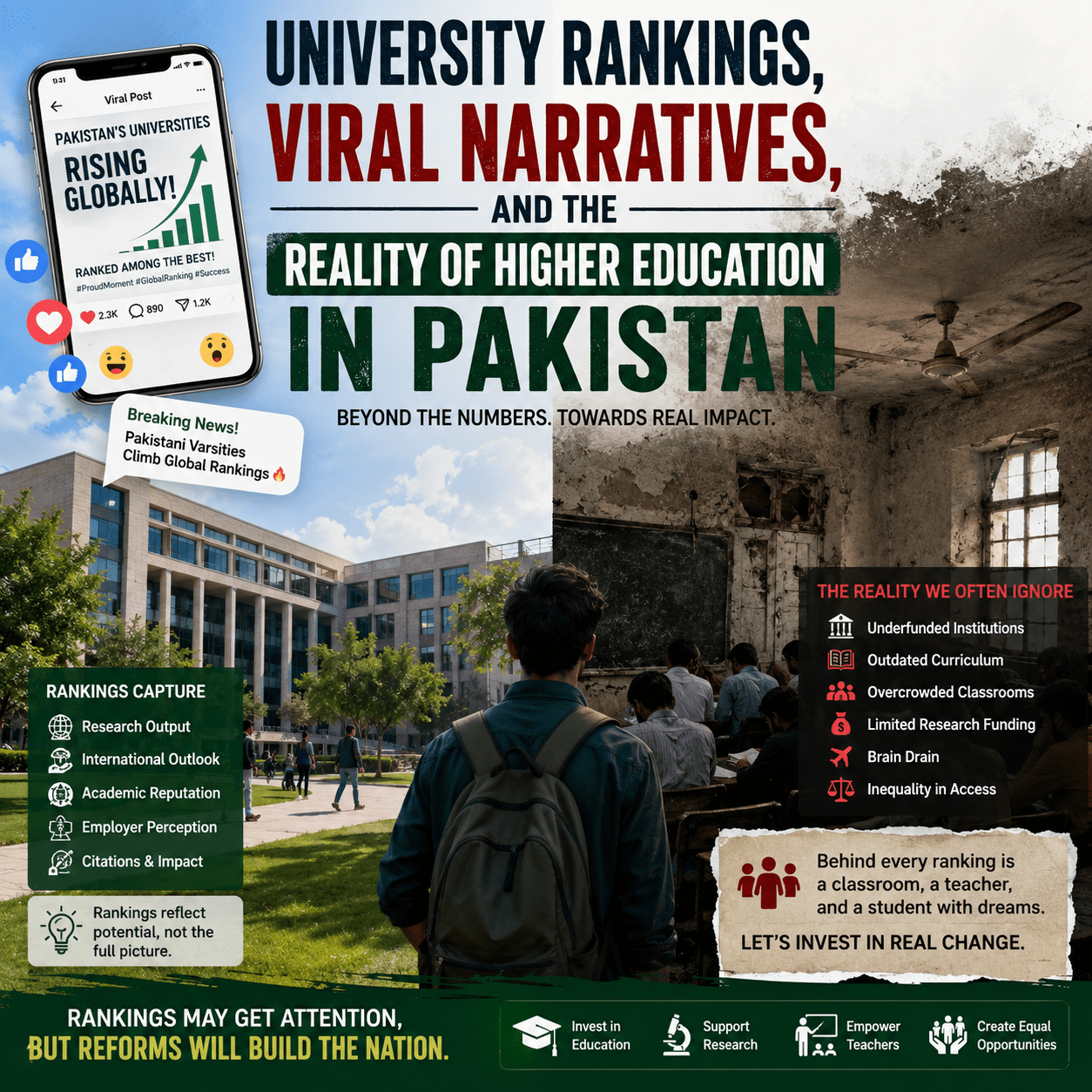
Every few months, a viral video, social media post, or online commentator claims that Pakistani universities are rapidly losing quality, producing unemployable graduates, and falling far behind the rest of the world. Recently, I came across a video asserting that no Pakistani university ranks among the world’s leading institutions and implying that the country’s entire higher education system is in serious decline.
Such claims attract attention because they are simple, dramatic, and emotionally appealing. Unfortunately, they often oversimplify a much more complex reality.
The real question is not whether Pakistani universities face challenges—they certainly do. The more important question is whether the quality of university education is declining across the board. The evidence suggests that the answer is far more nuanced than a simple “yes.”
What Do the Major Global Rankings Actually Show?
The criticism often heard on social media appears to be based on international ranking systems such as the QS World University Rankings and the Times Higher Education (THE) World University Rankings. These are among the most widely recognized global ranking frameworks and deserve serious consideration. However, their findings should be interpreted carefully.
Recent editions of both ranking systems include a significant number of Pakistani universities among thousands of institutions evaluated worldwide. While no Pakistani university currently occupies a place among the global top 100, several are ranked within the top few hundred institutions, and many more are represented across various ranking bands.
This distinction is important. The absence of a university from the global top 100 does not mean the absence of quality higher education. Rather, it indicates that Pakistani universities operate in a highly competitive international environment where institutions in developed economies often benefit from substantially larger research budgets, stronger internationalization, greater endowments, and decades of accumulated academic reputation.
It is equally important to understand what these rankings actually measure. Indicators typically include research output, citation impact, academic reputation, employer reputation, international outlook, industry engagement, and sustainability. While these are valuable measures, they do not fully capture the quality of teaching, student learning experiences, graduate transformation, social mobility, community engagement, or contributions to national development.
Therefore, rankings should be viewed as useful benchmarks rather than definitive judgments. They can help identify areas for improvement and encourage universities to aspire to global standards. However, reducing the entire discussion about educational quality to a single rank or the absence of a top-100 position risks oversimplifying a much more complex reality.
Rankings Do Not Tell the Whole Story
Even beyond the limitations of ranking methodologies, educational quality is a multidimensional concept. A university’s success cannot be measured solely through research metrics or international visibility.
The true impact of higher education can also be seen in the quality of teaching, student development, graduate employability, innovation, ethical leadership, and service to society. These dimensions are far more difficult to quantify but remain central to the mission of any university.
A university may rank modestly internationally yet still transform the lives of thousands of students through quality teaching and meaningful learning experiences. Conversely, a strong ranking does not automatically guarantee excellence in every aspect of education.
Expansion Does Not Mean Decline
Pakistan’s higher education sector has expanded dramatically over the last two decades. More universities have been established, student enrolment has increased significantly, and access to higher education has broadened.
Whenever a system expands rapidly, maintaining uniform quality becomes more challenging. However, expansion should not automatically be interpreted as deterioration.
Millions of young Pakistanis today have access to higher education opportunities that were unavailable to previous generations. The challenge is not that universities have expanded; the challenge is ensuring that quality assurance mechanisms, faculty development, infrastructure, and academic standards keep pace with growth.
The Real Issue: Uneven Quality
Perhaps the most accurate observation is that quality varies considerably across institutions and even across departments within the same institution.
Some universities continue to produce strong graduates, undertake meaningful research, develop industry partnerships, and contribute significantly to national development. Others struggle with outdated curricula, limited resources, governance issues, and insufficient faculty development.
Therefore, speaking about “Pakistani universities” as though they constitute a single homogeneous system is misleading. There are institutions that are improving, institutions that are stagnating, and institutions that require substantial reform.
The discussion should focus on identifying specific weaknesses and proposing solutions rather than making sweeping generalizations.
Employers Are Asking for Different Skills
Another factor often overlooked is the changing nature of work itself.
Today’s employers increasingly seek graduates who possess critical thinking, communication skills, adaptability, digital literacy, problem-solving ability, teamwork, and a willingness to learn continuously. Traditional degree programs sometimes struggle to keep pace with these evolving expectations.
When graduates face difficulties in the job market, it is tempting to place all responsibility on universities. However, employability is influenced by multiple factors, including economic conditions, industry growth, technological disruption, public policy, and individual student effort.
Universities certainly need to modernize curricula and strengthen engagement with industry. At the same time, students must recognize that a degree alone is no longer sufficient in an increasingly competitive and dynamic world.
Social Media Rewards Negativity
Content creators often gain more engagement from alarming headlines than balanced analysis.
A statement such as “Pakistan has no world-class universities” generates outrage, comments, and shares. A nuanced discussion about research funding, quality assurance, faculty development, accreditation standards, and curriculum reform receives far less attention.
This is not unique to higher education. Social media algorithms tend to reward certainty, controversy, and sensationalism rather than complexity and context.
As consumers of information, we should therefore be cautious about accepting viral claims without examining evidence. Educational policy deserves thoughtful analysis, not simplistic narratives.
What Should We Be Talking About?
Instead of asking whether university education is collapsing, we should focus on more constructive questions:
- How can faculty development be strengthened?
- How can universities better align curricula with future workforce needs?
- How can industry-academia collaboration be improved?
- How can quality assurance systems become more effective?
- How can universities promote innovation and entrepreneurship?
- How can higher education become more accessible while maintaining quality standards?
- How can universities develop graduates who are both employable and socially responsible citizens?
These are the conversations that can genuinely improve higher education.
Conclusion
Pakistan’s higher education sector faces undeniable challenges, but the narrative of universal decline is neither accurate nor helpful. The reality is a mixture of progress, expansion, achievement, inconsistency, and areas requiring reform.
The fact that Pakistani universities continue to be represented in internationally recognized ranking systems demonstrates that the issue is not the absence of quality, but rather the need to accelerate our progress toward greater competitiveness and excellence.
Educational quality cannot be judged solely through rankings, viral videos, or social media commentary. It must be assessed through a broader lens that considers teaching effectiveness, student outcomes, research contributions, societal impact, and continuous improvement.
The future of higher education in Pakistan will not be shaped by sensational claims. It will be shaped by informed debate, evidence-based policy, institutional accountability, and a collective commitment to excellence.
The writer is Director, University Institute of Management Sciences (UIMS) at Pir Mehr Ali Shah Arid Agriculture University, Rawalpindi. With more than three decades of experience in higher education, she has contributed extensively to academic leadership, quality assurance, and business education in Pakistan. Her areas of interest include higher education policy, management education, leadership development, and institutional excellence.